
There is a specific moment most language learners know well.
You have put in real time: classes, apps, immersion, travel. You can hold a conversation. You understand the news, mostly. But authentic reading (a novel, a newspaper column, a text from someone's grandmother) still feels like a wall. The vocabulary moves faster than you do. The sentences are longer. There is no hint system.
On one side of that wall: learner materials, children's books, simplified texts. On the other: authentic literature that assumes a native reader's vocabulary and cultural fluency. The gap between them is enormous, and for most learners, it stays uncrossed.
That gap is what Omorphos Publishing was built to close. There are ideas, relationships, and ways of seeing the world that are only fully available in the language they were made in. A translation is always a compromise. We want to give you the original.
Where this comes from
Omorphos Publishing was built by people with formal training in linguistics: how language works, how it's acquired, and how it varies across registers and cultures.
We've learned languages through immersion, through formal study, through reading, through conversation, across the full range of listening, speaking, reading, and writing. Not every method works for every dimension of a language. That experience is built directly into how these books are designed.
We've also learned languages by living among native speakers, in the places where the language is actually alive, and felt firsthand what that exposure does that a classroom or an app cannot replicate.
The honest conclusion from all of it: reading in the language, at the right level, is the lever most learners never fully use. Not because they don't want to. Because the right materials have never existed for them.
What we believe
The right level is not a convenience. It is the mechanism.
Content that is calibrated just above your current level is not a pedagogical nicety. It is how acquisition actually happens. Too easy and nothing new enters. Too hard and nothing sticks. The space in between, where you can follow the meaning but have to reach for some of the language, is where the real work gets done.
Most learner materials are too easy. Most authentic literature is too hard. Calibration is the thing that makes the gap crossable. Every design decision in our books, the vocabulary selection, the sentence complexity, the scaffolding that fades across the series, exists to keep the reader in that space. Challenged enough to grow. Supported enough to continue.
You learn more when you actually want to keep reading.
The strongest predictor of whether reading-based acquisition works is the simplest one: whether the reader continues. A book abandoned at chapter three does nothing. You don't need research to know this is true. You've experienced it yourself. The book you couldn't put down taught you more than the one you dutifully finished.
We are not interested in habit mechanics. No streaks. No push notifications. No points. The engagement mechanism we use is the oldest one available: a story you need to finish. Characters you have spent time with. A plot that doesn't resolve. Suspense that makes you pick up the book tomorrow, not because an app reminded you, but because you need to know what happens next.
This is not a concession to entertainment. It is the design. Motivation is not separate from learning. It is the condition of learning.
What language gives you
Language is not just communication. It is access.
There are ideas that live most fully in the language they were first expressed in. There are relationships that only become possible when you stop translating and start understanding. A translation is always a compression. Something is always lost: the register, the rhythm, the untranslatable word that carries a whole way of seeing.
The goal of language learning, at its best, is not fluency as a party trick. It is access to a fuller version of the world, the ability to be present in a language the way someone who grew up in it is present. To read what they read. To understand what they laugh at. To feel, even briefly, what it's like to be inside a different way of thinking.
The catalog — and where it's going
Right now, we publish original fiction series in multiple languages. Each one is a multi-book arc. Each one is built on the same design principles: calibrated difficulty, real stakes, a story you actually want to finish.
We're expanding the catalog over time: new languages, new protagonists, new settings. Language is not one size. Neither is our catalog.
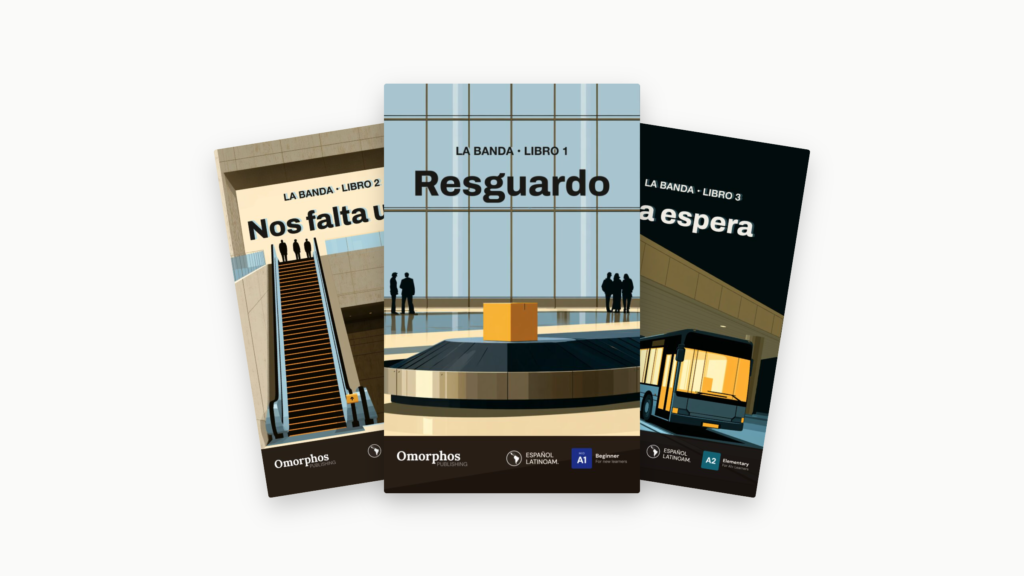
La Banda
The Carousel
An airport is run by companies that don’t employ each other, so the person in front of you never works for the one you’re complaining about. Four books, four people it happens to, and nobody is lying to any of them. Original fiction written in Latin American Spanish, running from A1 to A2.
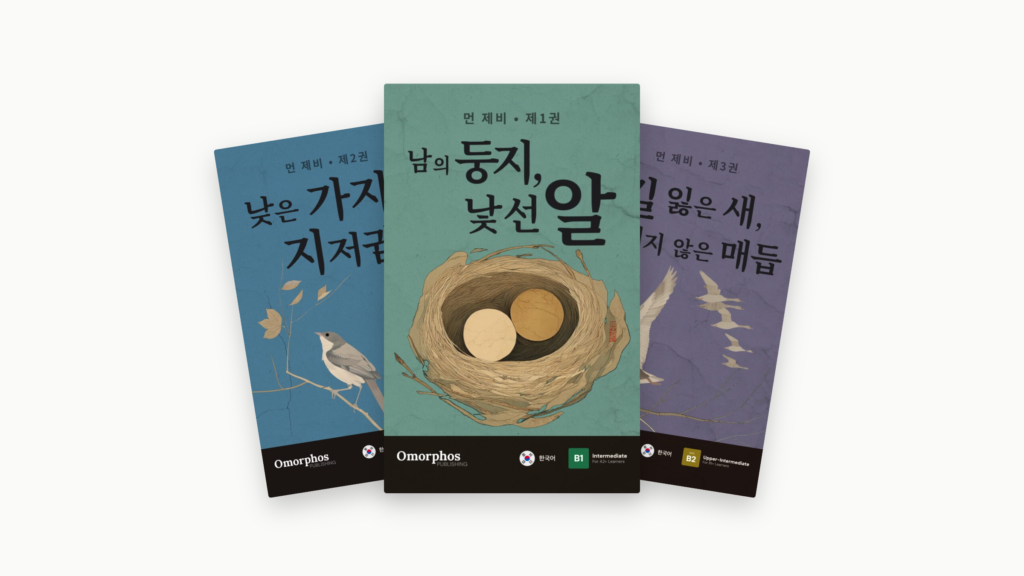
먼 제비 (Meon Jebi)
Distant Swallow
Yun Jae-seong is a researcher tracking Korean cultural heritage scattered abroad — colonial-era seizures, wartime looting, fraudulent sales. Original investigative fiction written in Korean, running from B1 to C1.
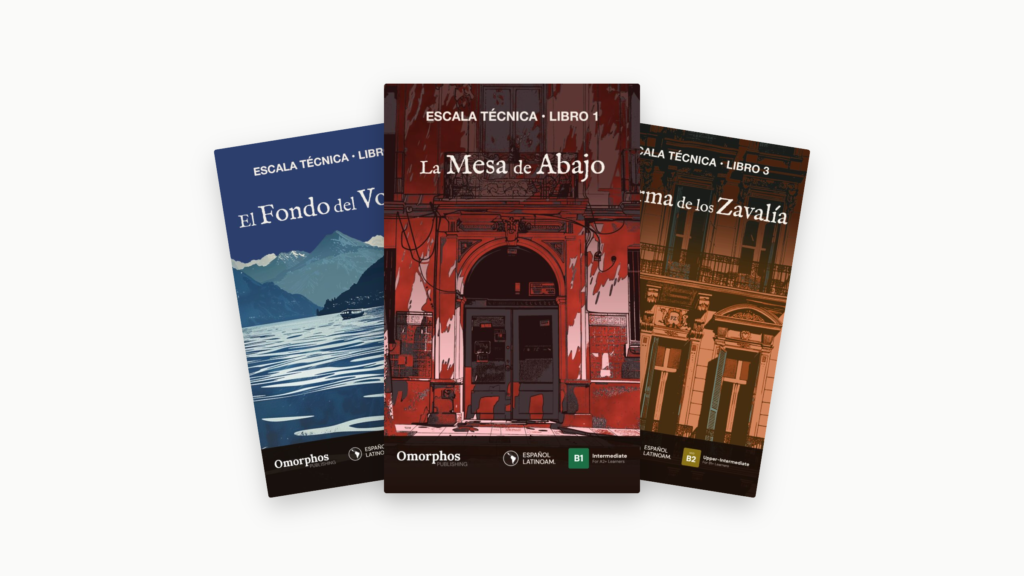
Escala Técnica
Technical Stopover
Valentina Reyes quit investigative journalism to travel Latin America for a living — great restaurants, fascinating cities, the kind of work that looks like a permanent vacation. Except paradise has a back of house. Five check-ins. Five cover-ups. And one name that keeps turning up underneath all of it.
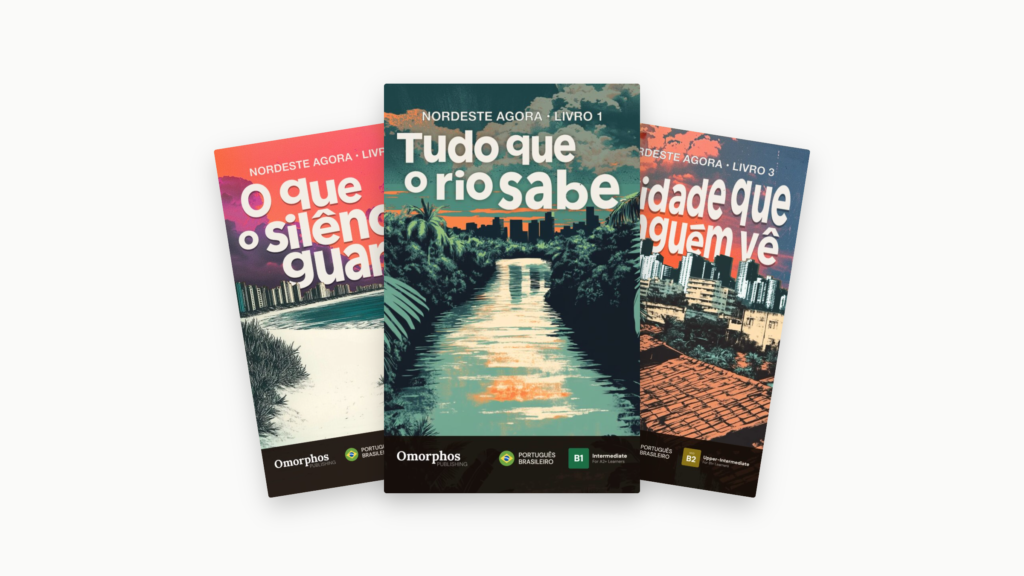
Nordeste Agora
Northeast Now
Five books, five cities in the Northeast of Brazil, and a reporter who keeps asking after everyone else has stopped. Original investigative fiction written in Brazilian Portuguese, running from B1 to early C1.