
Most reading advice for language learners is one of two things: a list of children’s books, or an instruction to go read the news. Neither is much use once you’re past the beginning and not yet fluent, which is where most people spend the longest.
This page covers that stretch, roughly B1 to C1. If you’re just starting, this isn’t the page for you yet. The beginning is well served, and almost any structured beginner course will do more for you right now than anything here.
The thing that makes Brazilian Portuguese different
Before any recommendation, the problem specific to this language.
Brazilians write one Portuguese and speak another, and the distance between them is unusually large. Linguists have argued for decades about whether it qualifies as diglossia, two coexisting varieties with their own grammars, and the label is still contested. The gap itself isn’t.
WRITTEN
Nós iremos ao mercado e compraremos o que falta.
Spoken
A gente vai no mercado e compra o que falta.
Different subject, different tense construction, different preposition, and both are correct. The first is what you’ll meet in a novel or a newspaper. The second is what you’ll meet in a message from a friend. Neither prepares you for the other.
This has a direct consequence for what you read. If your entire reading diet is books and journalism, you can end up able to follow a published article and lost in a WhatsApp thread, which is a strange and demoralizing place to be, and it happens constantly. The written language is not a formal version of the spoken one. It’s a different set of habits.
So the reading mix below isn’t only about difficulty. It’s also about making sure both varieties are in it.
Most advice for this language quietly assumes the written variety is the real one and the spoken variety is a casual deviation from it. It isn’t. Plan for both.
B1 — you can follow a conversation, and a novel still looks impossible
What to read
4 items-
 Tudo que o rio sabe Our book
Mariana Salgado is sent from Recife into the interior of Pernambuco to find out what happened to an environmental inspector who vanished a week before he was due to testify. She has his field notebook, a set of coordinates that don't match any official map, and a fisherman who says almost nothing at all. The river holds more than anyone is willing to say out loud.
- Intermediate Portuguese Short Stories
Ten stories by a Brazilian author, each with a summary and vocabulary list at the end. The most established option at this level and a reasonable first thing to finish. The gap worth knowing about: idioms tend to appear without explanation, so you will meet phrases like dor de cotovelo, literally elbow pain, meaning jealousy, and be left to work them out or look them up. There's also an audiobook edition, which is worth having if you want the same text in your ears.
- Portuguese Short Stories for Beginners and Intermediate Learners
Every story comes with a Portuguese-English vocabulary list, comprehension questions, and a full English translation, which makes it the most heavily supported option here, and the easiest to lean on too hard. Reading the vocabulary list before the story rather than after works better than it sounds. At 85 pages it's a short commitment, which is the point.
- Short Stories in Brazilian Portuguese: for beginners and intermediate learners (CEFR A2-B1)
Part of a series that actually ladders, A1–A2 through A2–B2, which is rare in Brazilian Portuguese and useful if you want to step up without changing author or format. New Horizon: Brazilian Portuguese Through Stories for Intermediate Learners is the one to look at if you're already comfortable at B1; it goes to B2 and includes audio and exercises. Small print runs and few reviews, so less established than the bigger imprints, but the levelling is more honest than most.
And for the daily-contact half
Not the news yet. That comes at B2, when you can finish an article rather than sample one.
What you want now is something written in the spoken variety. Comments under a Brazilian video, replies on social media, the lyrics of a song you already like. Ninety seconds a day, not an hour. It will look wrong compared to what your textbook taught you, and that reaction is the entire reason to do it.
B2 — real books become possible, but not all of them
What to read
5 items-
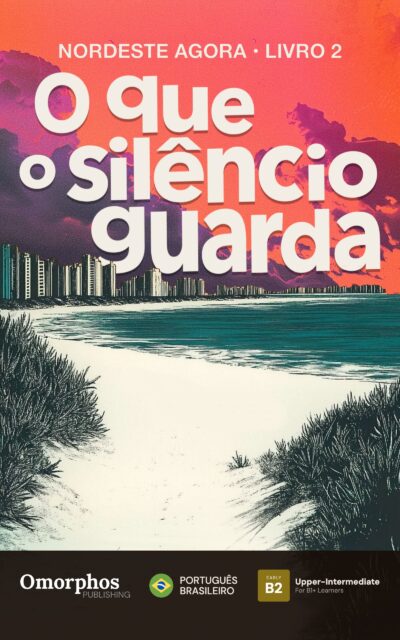 O que o silêncio guarda Our book
Coming Nov 9
Eight months of court reporting have taught Mariana Salgado what a clean file looks like. She is sent to Fortaleza to write about a neighborhood music stage, and the file she ends up reading there is immaculate: every notice served, every deadline met, every signature where it belongs. Two hundred families have left Vila Aurora. She arrives certain she already knows the shape of this story.
- Short Stories in Brazilian Portuguese for Intermediate Learners (Quer Brigadeiro?)
The upper end of the Meireles series, and the reason to start with her at B1: you can climb without changing author or format, which is worth more than it sounds when you're building a habit. Free audio is included, so the same text can go in your ears on a commute. The A2–B2 span is wide enough that the early stories will feel easy if you're solidly B2 already.
- Quarto de Despejo: Diário de uma Favelada
When this came out in 1960, it outsold Jorge Amado, Brazil's most famous novelist at the time. A favela diary, written on scavenged paper, became the best-selling book in the country.
Written at night on scavenged paper by a woman raising three children in a São Paulo favela, and published in 1960. She had two years of schooling, so the prose is plain and direct, no literary scaffolding to decode. It's a diary, so it comes in short dated entries: read three pages and stop without losing anything.
- O meu pé de laranja lima
Narrated by a child, which does most of the work: simple sentences, plain vocabulary, and a lot of the affectionate register Brazilians use with children and each other. Fiction, but without the literary machinery that makes most Brazilian novels hard at this level.
- O Alquimista
Short sentences, linear narrative, no structural tricks. The real advantage is that a lot of readers already know the story in English, and knowing the plot lets you read for how it's said rather than for what happens, which is the same trick that makes international news a good starting point.
Honest caveat: Coelho divides opinion sharply, in Brazil and elsewhere. The recommendation here is about readability, not literary merit.
Where the news becomes useful
3 items- G1
Brazil's most-visited news portal, and free. Registration is optional rather than required, which matters more than it sounds when most major Brazilian papers sit behind paywalls. Articles, video clips and podcasts on the same page, so you can read a story and then hear it. Newsrooms in Rio, São Paulo, Brasília, Belo Horizonte and Recife, which means regional coverage rather than a São Paulo view of the country.
- BBC News Brasil
The best place to start with news, for a reason that isn't obvious: it covers international stories, so you often already know what happened. Knowing the story lets you read for how it's said rather than for what occurred, and it gives you a way to check whether you actually understood. Free, no paywall, and most articles have an accompanying video.
- Agência Brasil
Brazil's public news agency, closer to a wire service than the commercial outlets, plainer and less stylized. Useful when you want the language to stay out of the way of the facts.
One thing worth doing deliberately: start with international stories rather than Brazilian ones. If you already know what happened, you can read for how it’s said instead of for what occurred, and you have a way to check whether you actually understood. Brazilian domestic politics is the hardest possible entry point, because you’re decoding the language and the context at once.
C1 and beyond — the graded books are now the easy read
Where to start with Brazilian literature
3 items- O Alienista
Machado de Assis is the name most Brazilians reach for first when talking about their own literature, and this novella is one of the most-read ways into his work.
A novella rather than a novel, which is why it belongs here: it's short enough to finish, and finishing something canonical does more for your confidence than starting something famous. The Portuguese is nineteenth century and you will feel that from the first page.
It's the most-reviewed single-work Machado de Assis edition in Portuguese, which suggests it's genuinely being read by learners, not just assigned in school. - Quarto de Despejo: Diário de uma Favelada
When this came out in 1960, it outsold Jorge Amado, Brazil's most famous novelist at the time. A favela diary, written on scavenged paper, became the best-selling book in the country.
Written at night on scavenged paper by a woman raising three children in a São Paulo favela, and published in 1960. She had two years of schooling, so the prose is plain and direct, no literary scaffolding to decode. It's a diary, so it comes in short dated entries: read three pages and stop without losing anything.
- Estação Carandiru
Drauzio Varella is practically a household name in Brazil, decades on TV and in the newspaper talking about health, so most readers already know his voice before they open this book.
A doctor's account of years working inside São Paulo's Carandiru prison. Direct journalistic prose, and structured as short self-contained chapters, which makes it unusually easy to read in segments rather than in a sustained run.
Not sure which of these you are?
Levels are bands, not thresholds, and most people place themselves lower than they actually read. If you’re guessing between two sections, take the lower one. A book you finish beats a book you were technically ready for.
Tips for success
-
Read past unknown words
If you are stopping more than about five times per hundred words, that is useful information. It means dropping a level will get you reading faster.
-
Mix in the spoken variety
Novels and journalism build one half of Portuguese. Add the spoken variety too, comments and messages, so the first group chat you read does not catch you off guard.
-
Build up to the classics
The books a Brazilian was assigned in school are often a century-old Portuguese, worth reading once you are comfortable, and more rewarding then than as a starting point.