Skip to content
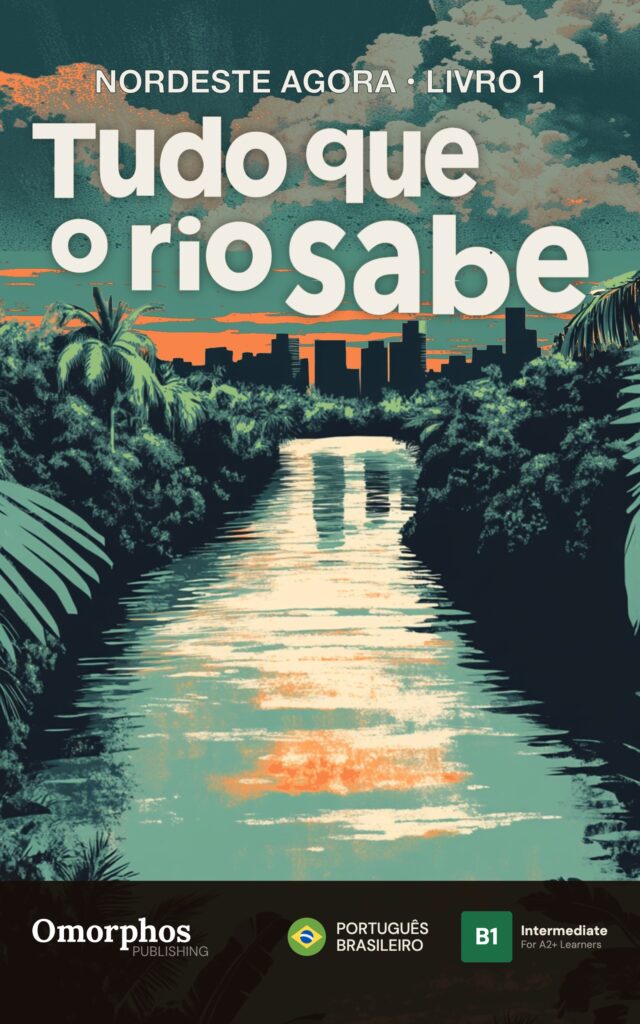
Tudo que o rio sabe

Purchase at:

$7.99 USD · Ebook

Buy on Amazon

Included with Kindle Unlimited

As an affiliate, we may earn a commission from a qualifying purchase made through the link above.

Not sure of the level? Read the first chapters free.

Nordeste Agora, Livro 1

Tudo que o rio sabe

A Brazilian Portuguese Novel for Intermediate Learners

Product Details

Language
Portuguese (BR)
Reading Level
B1B1 — Intermediate
Print Length
308 pages Reading time is roughly equivalent to 266 pages of English reading. Different retailers may estimate print length differently.
Reading Time
4h 16m
Publication Date
September 2026

Summary

A state water inspector found something in the Capibaribe. A week before he was due to testify, he disappeared. The police recorded it as a voluntary absence, and nobody else seemed interested in asking anything further.

Mariana Salgado has been in Recife eight months, at a small newsroom, and she is careful in a way that costs her — she will not say a thing out loud until she can prove it. Following the story takes her out of the city and into the interior of Pernambuco, where a fisherman who has watched the same bend of the river for fifty years agrees to let her use his name. On one condition: that she writes it right.

Written for people learning Brazilian Portuguese, at B1 on the CEFR scale. If you can read a Brazilian news article with occasional dictionary help, you can read this. The narration is clear and conversational; the harder stretches are short, and Mariana reads them beside you.

This is original fiction, written in Brazilian Portuguese for this level — not a simplified rewrite of someone else's book. You do not get a summary of the investigation. You read the field reports, the messages that arrive at eleven at night, and the pages of a missing man's notebook, in the order Mariana gets them.

Every chapter closes with a language note and vocabulary, and the running glossary is Mariana's own notebook. Book one of Nordeste Agora, a five-book series running B1 to early C1, with the support fading as you go.

Formatted Content in This Book

Told partly through in-story documents and messages — not just narration.

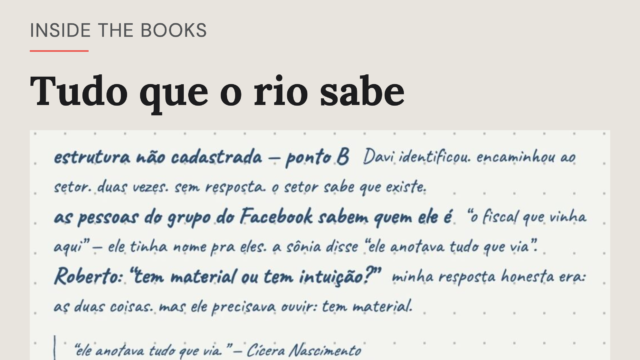
  • 33× Notebook Entries in this book Notebook Entries Handwritten notes scrawled mid-investigation — new vocabulary included.
  • 9× WhatsApp Conversations in this book WhatsApp Conversations Eavesdrop on a private thread, exactly as the characters typed it.
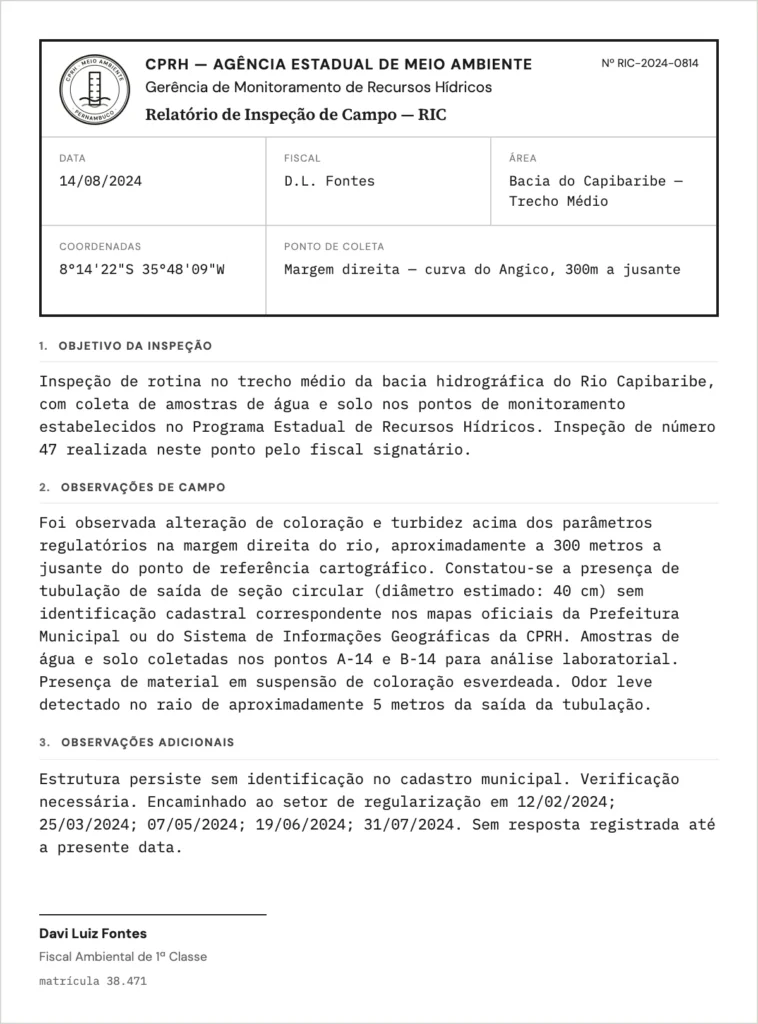
  • 8× Official Documents in this book Official Documents A government or institutional document, right down to the letterhead.
  • 4× Emails in this book Emails An email exchange that moves the story forward, one reply at a time.
  • 3× Social Media Posts in this book Social Media Posts A glimpse of the story's world through someone's own social feed.
  • 2× Legal Documents in this book Legal Documents A legal filing that turns out to matter a lot more than it looks.
  • 2× Field Reports in this book Field Reports A real inspection report — findings, letterhead, and all.
  • 2× Field Notebooks in this book Field Notebooks A character's own handwritten notebook, seen up close.
  • 2× News Articles in this book News Articles A full news story, laid out like real press coverage.
  • 1× Draft Article in this book Draft Article An article still in progress — red pen, edits, and all.
  • 1× WhatsApp Group Chat in this book WhatsApp Group Chat A whole group chat unfolding in real time — reactions, side comments, and all.
  • 1× Contract in this book Contract A signed contract at the center of the story.

Omorphos Publishing Author

How these books work

Every book in the catalog is built the same way. This is what that means.

  • You read the evidence, not a summary of it

    Documents reach the story the way they reach a reporter, and you read them before anyone tells you what they mean. Here an unknown number sends Mariana three lines about a state inspector who missed his own hearing. She asks who is writing. She asks how they got her number. Neither answer comes, and the reply that does come is a deadline.
  • You get what she gets, when she gets it

    Chapter one is prose, a message from a number that stops existing, and a page of Mariana’s own notebook where she writes down the three things she does not understand yet. The notebook is hers and it is also yours. The words she is unsure of are marked as unsure, because she is working it out at the same speed you are.

  • Nothing stops to explain itself

    New words arrive in the story before anyone explains them, then come back a few pages later in a slightly different shape. By the third time you know what they mean. Notes and a glossary sit at the end of each chapter, so the story is never interrupted, and you are not expected to look up everything you don’t recognize.

You can read it before you buy it

The opening of the book is the sample, with the notes and the glossary exactly as they appear inside. It is the surest way to find out whether the level fits, because it is the book and not a description of the book.
Frequently Asked Questions

If I use a different regional variant of the language, will I still get value from this content?

Yes, and the differences are worth having. Each series is written in one specific regional variety — Brazilian Portuguese, Latin American Spanish — because that’s how the language is actually spoken somewhere, by someone. You’ll meet vocabulary and expressions that belong to that place.

If you’re learning a different variety, you’ll understand nearly all of it, and you’ll notice the differences. That noticing is part of reading well in a second language rather than an obstacle to it.

I’m in a country where the book doesn’t appear to be available on my local Amazon.

For Spanish and Portuguese titles: our books are currently available through Amazon only, so if your local Amazon store isn’t showing a title, try a different regional Amazon store — availability can vary by market and by title.

For Korean titles: they aren’t on Amazon at all — look for them on Google Play Books or Apple Books instead. The book page always shows exactly where a given title is available.

If you’re still stuck, use the contact form and tell us which store, region, and title. We’re tracking where readers are running into this, and it directly informs which markets and platforms we open up next.

What formats are available?

Ebook. Spanish and Portuguese titles are in Kindle format on Amazon; some are also enrolled in Kindle Unlimited — the book page always shows whether a specific title is included, and if it is, KU subscribers can read it at no additional cost.

Korean titles are ebooks too, but through Google Play Books and Apple Books rather than Kindle, since Amazon’s Kindle store doesn’t support Korean-language publishing and Kindle Unlimited the way it does for our other languages.

You don’t need a Kindle device for the Amazon titles — the free Kindle app works on phones, tablets, and computers, and there’s a browser reader as well. Google Play Books and Apple Books each have their own free apps too.

We’re planning to bring titles to more platforms over time, selectively and title by title. Nothing else is announced yet.

Where can I buy the books?

Each book page on this site links straight to the purchase page. We don’t sell directly.

Where a book is depends on its language. Spanish and Portuguese titles are on Amazon, with Kindle Unlimited enrollment varying by title — the book page always shows whether a given title is included. Korean titles are on Google Play Books and Apple Books instead, since Amazon’s Kindle store doesn’t support Korean the same way. We’ll be adding more platforms over time, one title at a time rather than all at once.

Is it on Kindle Unlimited?

For our Spanish and Portuguese titles, it depends on the book — Kindle Unlimited enrollment is decided title by title, not across the whole catalog at once. The book page always shows whether a specific title is included. When it is, KU subscribers can read it at no extra cost.

Our Korean titles aren’t on Kindle at all, so Kindle Unlimited doesn’t apply to them — see “Why aren’t the Korean books on Amazon or Kindle Unlimited?” below.

Why are the Spanish and Portuguese books only on Amazon?

Being on Amazon lets us enroll those titles in Kindle Unlimited, which means a reader can try a book without deciding in advance whether it’s the right level for them — and that matters more for language learners than for most readers. Nobody wants to spend money finding out a book is too hard.

It’s not permanent for those languages either. We’ll be opening up other platforms as we go, title by title. If you’re waiting on a specific one, tell us through the contact form — it genuinely affects the order we get to them.

This doesn’t apply to our Korean titles, which are on other platforms from the start — see the next question.

Do I need a Kindle device to read these?

No, for our Spanish and Portuguese titles on Amazon — the free Kindle app runs on iPhone, Android, iPad, Mac, and Windows, and you can read in a browser too. Any device you already own will work.

Our Korean titles are on Google Play Books and Apple Books instead, each with their own free apps — see “Where can I buy the books?”

More FAQs