
Coming Nov 9
One email on release day. Nothing else.
Not sure of the level? Read the first chapters free.
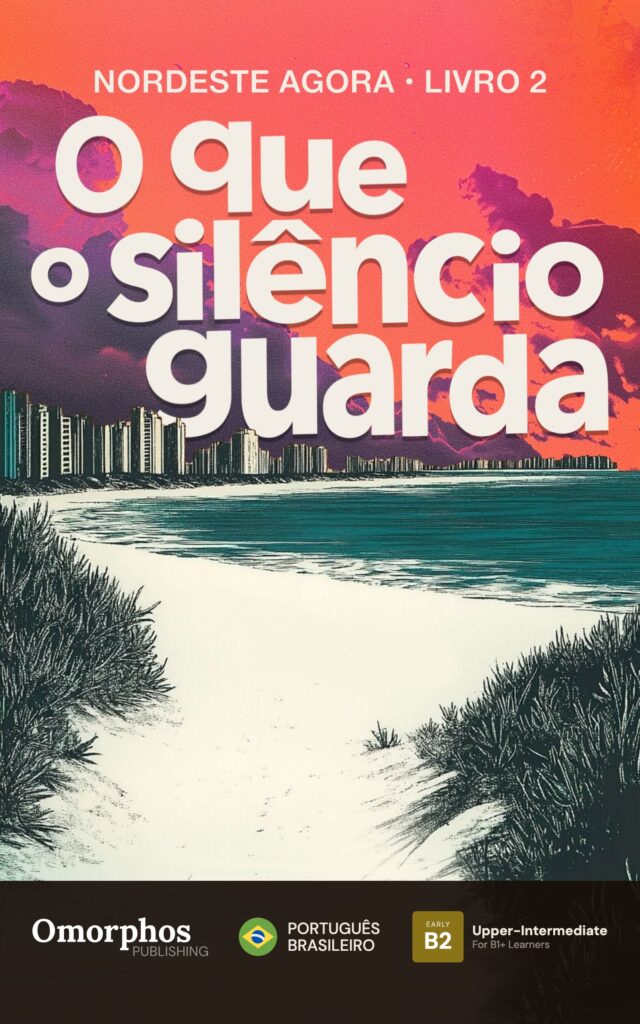
Nordeste Agora, Livro 2
O que o silêncio guarda
A Brazilian Portuguese Novel for Upper-Intermediate Learners
Product Details
- Language
- Portuguese (BR)
- Reading Level
- B2Early B2 — Upper-Intermediate
- Print Length
- 285 pages Reading time is roughly equivalent to 240 pages of English reading. Different retailers may estimate print length differently.
- Reading Time
- 3h 51m
- Publication Date
- November 2026
Summary
The Palco Comunidade is four days of forró at the closing weekend of Fortaleza's biggest festival, and the organization that runs it opens every door Mariana Salgado asks about.
Two hundred families have already left the neighborhood behind the stage. There were consultations. There were assemblies. The minutes record that nobody spoke against it.
Mariana got her last story right, and that is the problem — she arrives already certain she knows the shape of this one.
With her is Isabela Firmino, nineteen, three weeks into her first job in a newsroom, who keeps asking the question Mariana has stopped asking.
The festival ends on Sunday. After that, everyone goes home.
Written for B2 readers. If you finished a B1 novel and can follow a Brazilian news article without stopping at every sentence, you can start here. Part 1 opens at the pace Book 1 closed at; from Part 2 the administrative language arrives.
This is original fiction, written in Brazilian Portuguese at this level, not a simplified rewrite of someone else's book. It moves through a relocation agreement, a press credential with small print on the back, an association's minutes, and an email sent at 22:47, because getting people to talk takes a different Portuguese each time.
Every chapter closes with a language note, words from that chapter, and a page from Mariana's notebook. Book 2 of Nordeste Agora, a five-book series running B1 to C1.
Formatted Content in This Book
Told partly through in-story documents and messages — not just narration.
- 33× Notebook Entries in this book Notebook Entries Handwritten notes scrawled mid-investigation — new vocabulary included.
- 7× Institutional Registries in this book Institutional Registries A shared institutional record — the kind of list two organizations both sign off on.
- 4× WhatsApp Conversations in this book WhatsApp Conversations Eavesdrop on a private thread, exactly as the characters typed it.
- 3× Official Documents in this book Official Documents A government or institutional document, right down to the letterhead.
- 3× Meeting Minutes in this book Meeting Minutes The official minutes from a meeting that changes everything.
- 2× News Articles in this book News Articles A full news story, laid out like real press coverage.
- 2× Emails in this book Emails An email exchange that moves the story forward, one reply at a time.
- 2× Press Credentials in this book Press Credentials An event access badge — front and back, exactly as it hangs on a lanyard.
- 1× Annual Report in this book Annual Report An organization's annual report, with a line worth reading twice.
- 1× Set list in this book Set list A musicianu2019s handwritten set list, folded in four u2014 nine songs with their keys, and a rest written into the middle of the run in heavier ink.
- 1× Festival Flyer in this book Festival Flyer A flyer for a local festival, worked right into the story.
- 1× Annotated Map in this book Annotated Map An official map with overlaid layers and numbered callouts flagging where they disagree.
- 1× Relocation Agreement in this book Relocation Agreement A resettlement agreement with real stakes behind the fine print.
- 1× Instagram Post in this book Instagram Post A social post pulled straight from a character's feed, comments and all.
- 1× Municipal Permit in this book Municipal Permit A city permit that ends up at the heart of the story.
- 1× Postcard in this book Postcard A postcard, handwritten side up — postmark, stamp, and all.
Frequently Asked Questions
If I use a different regional variant of the language, will I still get value from this content?
Yes, and the differences are worth having. Each series is written in one specific regional variety — Brazilian Portuguese, Latin American Spanish — because that’s how the language is actually spoken somewhere, by someone. You’ll meet vocabulary and expressions that belong to that place.
If you’re learning a different variety, you’ll understand nearly all of it, and you’ll notice the differences. That noticing is part of reading well in a second language rather than an obstacle to it.
I’m in a country where the book doesn’t appear to be available on my local Amazon.
For Spanish and Portuguese titles: our books are currently available through Amazon only, so if your local Amazon store isn’t showing a title, try a different regional Amazon store — availability can vary by market and by title.
For Korean titles: they aren’t on Amazon at all — look for them on Google Play Books or Apple Books instead. The book page always shows exactly where a given title is available.
If you’re still stuck, use the contact form and tell us which store, region, and title. We’re tracking where readers are running into this, and it directly informs which markets and platforms we open up next.
What formats are available?
Ebook. Spanish and Portuguese titles are in Kindle format on Amazon; some are also enrolled in Kindle Unlimited — the book page always shows whether a specific title is included, and if it is, KU subscribers can read it at no additional cost.
Korean titles are ebooks too, but through Google Play Books and Apple Books rather than Kindle, since Amazon’s Kindle store doesn’t support Korean-language publishing and Kindle Unlimited the way it does for our other languages.
You don’t need a Kindle device for the Amazon titles — the free Kindle app works on phones, tablets, and computers, and there’s a browser reader as well. Google Play Books and Apple Books each have their own free apps too.
We’re planning to bring titles to more platforms over time, selectively and title by title. Nothing else is announced yet.
Where can I buy the books?
Each book page on this site links straight to the purchase page. We don’t sell directly.
Where a book is depends on its language. Spanish and Portuguese titles are on Amazon, with Kindle Unlimited enrollment varying by title — the book page always shows whether a given title is included. Korean titles are on Google Play Books and Apple Books instead, since Amazon’s Kindle store doesn’t support Korean the same way. We’ll be adding more platforms over time, one title at a time rather than all at once.
Is it on Kindle Unlimited?
For our Spanish and Portuguese titles, it depends on the book — Kindle Unlimited enrollment is decided title by title, not across the whole catalog at once. The book page always shows whether a specific title is included. When it is, KU subscribers can read it at no extra cost.
Our Korean titles aren’t on Kindle at all, so Kindle Unlimited doesn’t apply to them — see “Why aren’t the Korean books on Amazon or Kindle Unlimited?” below.
Why are the Spanish and Portuguese books only on Amazon?
Being on Amazon lets us enroll those titles in Kindle Unlimited, which means a reader can try a book without deciding in advance whether it’s the right level for them — and that matters more for language learners than for most readers. Nobody wants to spend money finding out a book is too hard.
It’s not permanent for those languages either. We’ll be opening up other platforms as we go, title by title. If you’re waiting on a specific one, tell us through the contact form — it genuinely affects the order we get to them.
This doesn’t apply to our Korean titles, which are on other platforms from the start — see the next question.
Do I need a Kindle device to read these?
No, for our Spanish and Portuguese titles on Amazon — the free Kindle app runs on iPhone, Android, iPad, Mac, and Windows, and you can read in a browser too. Any device you already own will work.
Our Korean titles are on Google Play Books and Apple Books instead, each with their own free apps — see “Where can I buy the books?”
More to Read
What your textbook does, and what a novel does
A textbook teaches you the language explicitly. A novel builds your ability to handle language in context by making you infer meaning as you…
Read more →
A hundred years of Brazilian writing on the Capibaribe
Our first Portuguese novel, Tudo que o rio sabe, is set on the Capibaribe. Mariana Salgado is a reporter. Recife sends her up into…
Read more →