
Our Korean novel, 남의 둥지, 낯선 알 (Namui Dungji, Natseon Al), turns on a painting that hangs in a museum in Paris with thirty-three years missing from its record. The case underneath it is invented. The situation is not.
In the spring of 2011, France sent 297 volumes of Joseon royal records to South Korea, where they have been held since. The Bibliothèque nationale de France remains their owner. How that arrangement came about is stranger than either a return or a refusal, and the short version is that a French court said no first.
What are these books?
An 의궤 is a protocol book. When the Joseon court held a wedding, a funeral, a coronation or a rebuilding, officials recorded what was done in enough detail that the same event could be staged again: who stood where, what was carried, what everything cost, what the banners looked like. They are administrative records, kept so the next generation of officials would not have to guess.
The copies made for the king to read were kept on Ganghwa Island, at an annex of the royal library. In 1866 a French punitive expedition under Admiral Roze took the island. The archives were carried onto the ships and sailed to France.
How were they found?
They were not hidden. They were filed. In Paris the volumes were cataloged as Chinese material and sat that way, unidentified, for more than a century.
박병선 came to the Bibliothèque nationale as a special researcher in 1967. In 1972, working through the library’s Korean holdings, she identified the second volume of the 직지심체요절. Three years later, in 1975, she found the 의궤 in a store at the library’s Versailles annex. In 1985 she published the bibliographic work recording what was there and where, which gave South Korean officials a documented basis for asking for them.
What happened when South Korea asked?
Asking went on for decades. In 1993 President Mitterrand carried a single volume to Seoul during a state visit, and that volume stayed. The rest did not follow.
So a South Korean cultural heritage organization went to court in France. The suit asked for the annulment of the culture minister’s refusal to move the manuscripts out of the public domain, which is the step that would have had to come before any transfer. On 18 December 2009 the Tribunal administratif de Paris dismissed it.
The association appealed.
Why did the legal route fail?
The obstacle is the legal status of an object held in a French public collection. Such an object is inalienable: it cannot be handed to another state as it stands. It has to be removed from the public domain first, through a separate legal procedure.
That procedure exists, and this is the part most accounts skip. An object can be declassified out of the public domain, on expert advice, by a decision that rests with the culture ministry. The circumstances of an acquisition are among the things that can count in its favor. A door exists. Somebody has to open it.
The culture minister declined to, and the courts upheld that refusal. Their reasoning is worth reading closely. The archives were deposited at the Bibliothèque nationale by the navy ministry in July 1867, and that deposit brought them into the movable public domain of the French state. How they had been obtained the year before was, in the appeal court’s words, without legal consequence for that incorporation. It is a ruling about when a thing entered a collection, not about whether it should have.
What route brought them to South Korea anyway?
Eleven months after the court ruled, the two governments settled the arrangement. It was agreed at the Seoul G20 summit in November 2010, between the two presidents, and its first article does not describe a return. It describes a loan, for a renewable period of five years.
The first seventy-five volumes reached South Korea on 14 April 2011. The shipments were completed in May. Counting the volume Mitterrand had brought in 1993, 297 are now held at the National Museum of Korea, and every one of them is French property.
The lawsuit outlived the handover. The appeal court rejected the association’s case in July 2013, more than two years after the volumes had arrived in Seoul, and the legal question stood exactly where it had stood in 2009.
The loan renews in five-year periods, by written notice passed through diplomatic channels. Nothing in the text makes that automatic, and nothing in it makes the arrangement permanent. Each renewal is an occasion on which the terms can be opened again.
What that looks like in practice: at the February 2021 renewal, the Bibliothèque nationale proposed a clause under which anyone using photographs of the 의궤 commercially would pay a fee to the library in Paris. The National Museum of Korea refused, on the grounds that a national institution gives its own images to the public for free so long as the source is credited. France accepted that, and no fee was charged. The episode also showed that a renewal could reopen questions about the terms of use.
One more clause matters. Article 4 says the loan is a unique act, that it cannot be invoked in any other situation, and that it sets no precedent. The books came home through a door the agreement locks behind them.
The court refused the claim on the legal status of the manuscripts in the French public domain, and the agreement that followed changed the mechanism rather than resolving the question of who owns them.
Back to the novel
In 남의 둥지, 낯선 알 a claim moves. Yun Jae-seong files, the file goes somewhere, somebody answers. In this case the claim was refused, and the volumes came to South Korea through an agreement between two governments rather than through a successful legal claim.
-
남의 둥지, 낯선 알 (Namui Dungji, Natseon Al)
먼 제비, 제1권
Seoul
Yun Jae-seong has been back in Seoul barely two months when a small Paris museum's quietest painting lands on his desk — a mountain-and-moon ink wash by a nearly forgotten Korean painter, its ownership blank for thirty years. The case takes him from a dust-choked government archive to an old man's living room, where the tea goes cold and almost nothing gets said. Every document insists the story is simple. No one in that room believes it.
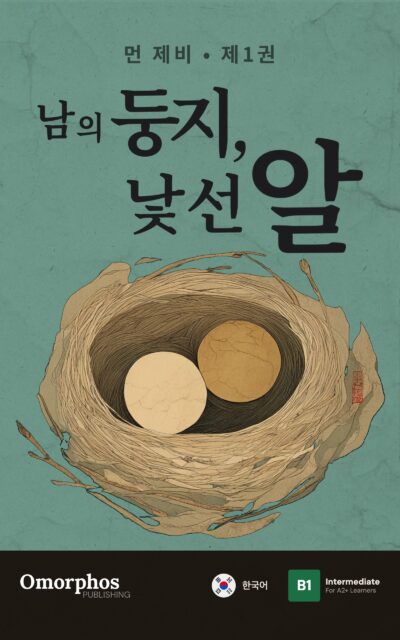
남의 둥지, 낯선 알 is the first book in 먼 제비 (Meon Jebi), from Omorphos Publishing.
Comments