Most reading advice for Korean learners is a list of webtoons and an instruction to try a short story. Both are reasonable and neither addresses the thing that actually stops people, which is that Korean prose is written in a grammatical register most courses teach you to avoid.
This page covers roughly B1 to C1. If you are still working through a beginner course, that course is doing more for you right now than anything here.
The thing that stops people, and it is not vocabulary
You learned 해요체. Almost every course starts there, because it is the safe spoken default and it keeps a beginner out of trouble.
Korean novels are not written in it. Narration uses 한다체, the plain style: 간다, 먹는다, 좋다, and in the past tense 갔다, 먹었다, 좋았다. If your textbook mentioned it at all, it probably described it as blunt or impolite, which is true of the spoken forms and misleading about the written ones.
The useful way to think about it: a novel is not talking to you. Korean marks the presence of a listener grammatically. Narration marks their absence. The plain style is not rude in a book, because there is nobody in the room to be rude to.
This is why the first Korean novel feels harder than the vocabulary predicts. You are not meeting unfamiliar words. You are meeting an unfamiliar ending on words you already know, on every single sentence.
Two things make it less work than it sounds:
- Most narration sits in the past tense, where the verb and adjective forms collapse into one ending. Drill ‑았다 / ‑었다 and you have the majority of the prose you will meet.
- And you already use it. Indirect quotation embeds the plain style inside perfectly polite speech: 간다고 했어요, 먹는다고 합니다. Learning it for reading pays back the next time you tell somebody what a third person said.
In a novel you will also switch registers constantly, because dialogue is written the way people speak while narration is not. That switch is worth welcoming rather than resenting. Which register two characters use with each other is information about their ages, their status and how close they are, and a shift from 존댓말 to 반말 partway through a book is an event in the story, not a slip.
Before you buy anything, check it was written in Korean
This trips up more learners of Korean than of any other language, because several of the most famous Korean books were not written in Korean.
Pachinko was written in English. So was Crying in H Mart. Both reach Korean readers in translation, and both appear constantly on lists of Korean books to read. Meanwhile some of the best-selling books in Korean bookshops are translations from Japanese, including 미움받을 용기.
None of that is a criticism of the books. It only means they will not teach you how Korean is written, because no Korean writer wrote them.
The check takes five seconds. On 교보문고, 알라딘 or 예스24, look at the listing for 원제 (original title) or 옮긴이 (translator). If either field is there, you are holding a translation. A book written in Korean lists only 지은이.
What the mix should look like
The Korean-specific complication is webtoons. They are native material, they are free, and there are thousands of them. They are also almost entirely dialogue, which means they are almost entirely in the registers you already know. That makes them the gentlest bridge into reading real Korean and it means they will not prepare you for a novel, because the register that stops people barely appears in them.
Read them. Enjoy them. Just do not count them as prose practice, because they are not.
If you have never finished anything longer than a textbook dialogue
You know several hundred words, you can follow a slow conversation, and a page of solid Korean text still looks like a wall.
What to read
2 items-
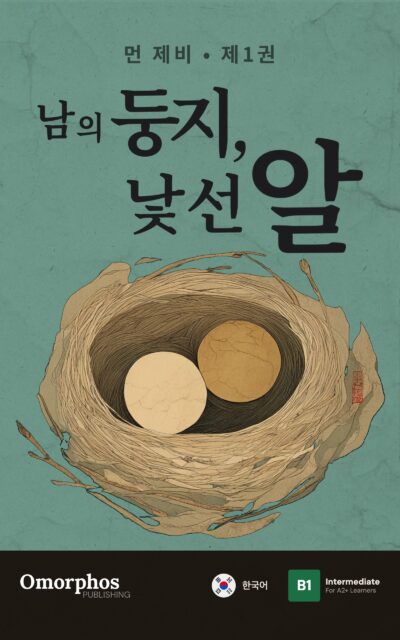 남의 둥지, 낯선 알 Our book
Yun Jae-seong has been back in Seoul barely two months when a small Paris museum's quietest painting lands on his desk — a mountain-and-moon ink wash by a nearly forgotten Korean painter, its ownership blank for thirty years. The case takes him from a dust-choked government archive to an old man's living room, where the tea goes cold and almost nothing gets said. Every document insists the story is simple. No one in that room believes it.
- 나는 나로 살기로 했다
A collection of very short illustrated essays, a page or two each, on resilience and self-acceptance — one of Korea's best-selling essay collections. Each piece ends, so it's easy to stop after three minutes without losing the thread.
Webtoons on Naver or Kakao are worth your time here too — free, endless, and mostly dialogue in registers you have already studied. Start with something slice-of-life rather than fantasy, so the vocabulary is the vocabulary of ordinary situations.
If you can read webtoons but a novel still stops you
This is the largest group and the one this page exists for. The bridge you have built is real and it is a bridge to dialogue, not to prose.
What to read
4 items- 아몬드
A YA novel about a boy who cannot feel fear or anger, and what happens to him at school. Winner of the Changbi Prize for Young Adult Fiction — written for Korean sixteen-year-olds, so the vocabulary is controlled without condescension. Short chapters, first person, plain sentences.
- 죽고 싶지만 떡볶이는 먹고 싶어
A memoir built from recordings of the author's own sessions with a psychiatrist, on persistent depression. Mostly dialogue, so it draws on the spoken registers a learner already knows, and it's broken into sessions, so it has real stopping points.
- 불편한 편의점
A million-seller set almost entirely in one Seoul convenience store, following a homeless man with amnesia taken in by the store owner. Episodic, heavy on dialogue, and the single setting means the vocabulary repeats until it sticks.
- 82년생 김지영
A novel about an ordinary Korean woman's psychological breakdown, used to narrate everyday sexism across her life — a landmark feminist-discourse bestseller that became a national conversation. The prose is deliberately flat, almost reportorial, with real statistics folded in, which leaves very little figurative language between the reader and the sentence.
If you can finish a contemporary novel
What to read
2 items- 달러구트 꿈 백화점
A department store that sells dreams to sleeping visitors, following a new employee learning the trade. A #1 domestic bestseller and breakout “healing fiction” hit. Episodic and gentle; the fantasy vocabulary is concrete and repeats, which is easier than it sounds.
- 채식주의자
A novel in three parts about a woman who stops eating meat and gradually withdraws from her body and family, told from the perspectives of her husband, brother-in-law, and sister. Winner of the 2016 International Booker Prize; Han Kang went on to win the 2024 Nobel Prize in Literature. Spare, literary, ambiguous prose — genuinely difficult for a learner despite its short length, not an easy pick.
Nonfiction is worth considering early, too — the standard advice is to graduate to literary fiction, which is close to backwards. Literary fiction is built on deviation from ordinary language, and deviation only registers if you have enough of the language to notice it. A history or a memoir generally is not built that way: chronology tells you where you are, the vocabulary is concrete, and if you already know roughly what happened, your whole attention goes to how it is being said.
Where to start with Korean literature
There is no Korean reading list, and the reason is structural rather than accidental.
Learners often go looking for the Korean equivalent of a national set text list and cannot find one. It does not exist. The national curriculum specifies what students should be able to do rather than what they must read, seven approved publishers each choose their own selections, and a 2014 statute bars university entrance exams from testing anything beyond the school curriculum, which prevents a canonical list from forming in the first place.
What functions as the substitute is a commercial exam-prep series reissued every year, which is a study aid rather than a canon.
So the honest version is: certain works recur. These are the ones almost every Korean adult read at school.
And the readable era is not where you would guess. The writers who invented modern Korean prose in the 1920s and 1930s produced some of the least approachable Korean for a foreign reader today, because it is dense with Sino-Korean vocabulary that has since fallen out of use, thick with regional dialect, and set in a material world that no longer exists. The most readable Korean prose is contemporary, and that is not a compromise.
Not sure which of these you are?
Levels are bands, not thresholds, and most people place themselves lower than they actually read. If you’re guessing between two sections, take the lower one.
Tips for success
-
Drill one ending
If you learn a single thing from this page, learn ‑았다 / ‑었다. Most Korean narration sits in the plain past tense, so one ending unlocks the majority of the sentences in front of you. It is a smaller job than it looks, and it is the one that stops a novel feeling foreign.
-
Use webtoons for dialogue and prose for narration
Both are worth your time and they build different things. Webtoons give you the spoken registers in volume, which is genuinely useful and is not what makes novels hard. Split the job on purpose rather than expecting one to cover the other.
-
Check for a translator before you buy
On any Korean bookshop listing, look for 원제 or 옮긴이. A book written in Korean lists only 지은이. Five seconds, and it is the difference between reading Korean and reading a translation of something written somewhere else.
-
Start contemporary and work backwards
Contemporary Korean is the most readable Korean, and reading it first is not a compromise or a detour. The dialect, the Sino-Korean vocabulary and the vanished material world in the older stories all get easier once the sentences themselves are automatic. Come back to them when they cost you less.